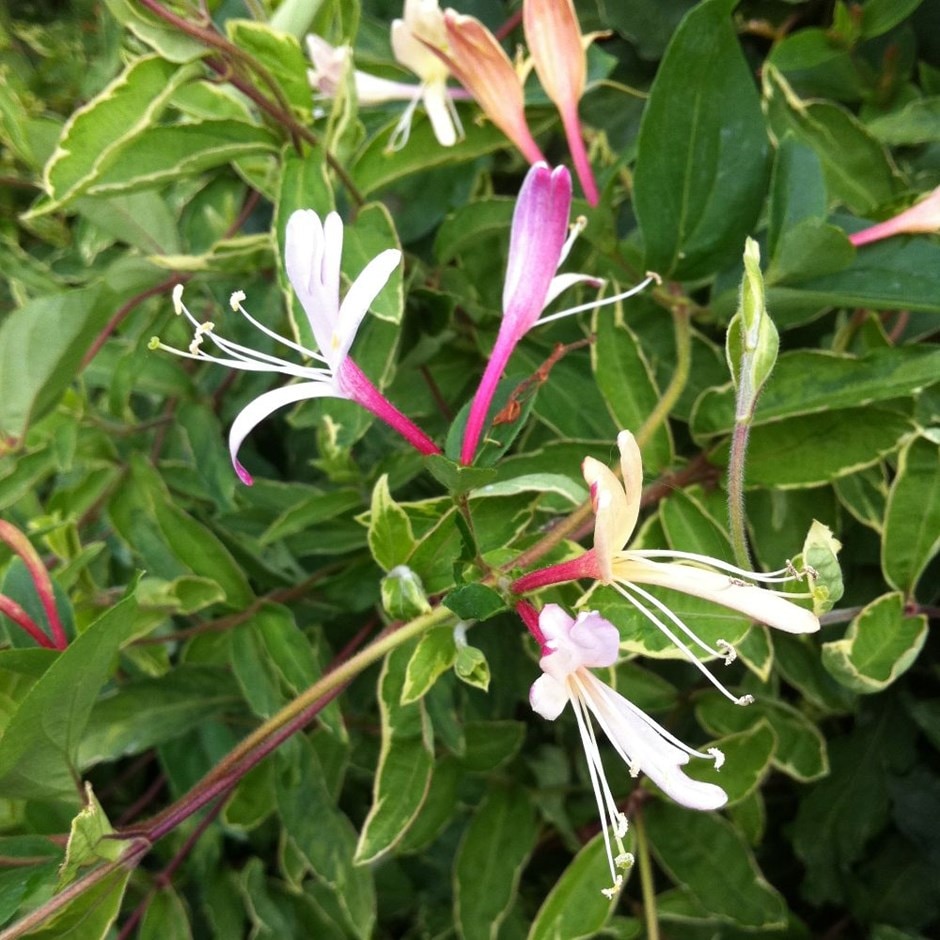
Lonicera japonica 'Dart's World'
semi-evergreen honeysuckle
- 3 litre pot | 60cm cane
- £29.99
- available to order from spring
Delivery options
- Standard £5.99
- Position: full sun or partial shade
- Soil: fertile, humus-rich, moist, well-drained soil
- Rate of growth: fast-growing
- Flowering period: April to August
- Hardiness: fully hardy
Often producing its highly scented flowers non-stop from late spring to autumn, this fast-growing climber will usually keep its rich green foliage throughout the winter too - especially if the temperatures do not drop too low. The blooms appear in open clusters, and as they age they change from rich pink to blush, and then creamy yellow, and if planted in a sunny, reasonably sheltered spot, their perfume is divine!
To avoid dry conditions, and to ensure good soil contact around the rootball, we advise planting climbers at least 30cm (12in), and preferably 45-60cm (18-24in) away from the base of a wall or fence. An even larger distance should be maintained when planting climbers beside an existing tree or shrub.
When planting, add some soil conditioner (well-rotted compost) to the planting hole and some mycorrhizal fungi to aid root establishment. Newly planted honeysuckles should be cut back by up to two thirds in their first full year after planting, in early spring. The resulting new growth can then be tied onto a frame, and nipped back when it reaches the desired height.
In subsequent years (again in early spring), thin out congested stems, and prune lanky stems back to healthy buds. Every few years, you may want to renovate your plant, and you can do this by cutting it back to around 60cm (24in) above the ground.
The subsequent mass of growth will need to be thinned and tied on as before. After pruning, apply a generous 5-7cm (2-3in) mulch of well-rotted compost or manure around the base of the plant.
When planting, add some soil conditioner (well-rotted compost) to the planting hole and some mycorrhizal fungi to aid root establishment. Newly planted honeysuckles should be cut back by up to two thirds in their first full year after planting, in early spring. The resulting new growth can then be tied onto a frame, and nipped back when it reaches the desired height.
In subsequent years (again in early spring), thin out congested stems, and prune lanky stems back to healthy buds. Every few years, you may want to renovate your plant, and you can do this by cutting it back to around 60cm (24in) above the ground.
The subsequent mass of growth will need to be thinned and tied on as before. After pruning, apply a generous 5-7cm (2-3in) mulch of well-rotted compost or manure around the base of the plant.
- Humans/Pets: Fruit are ornamental - not to be eaten
